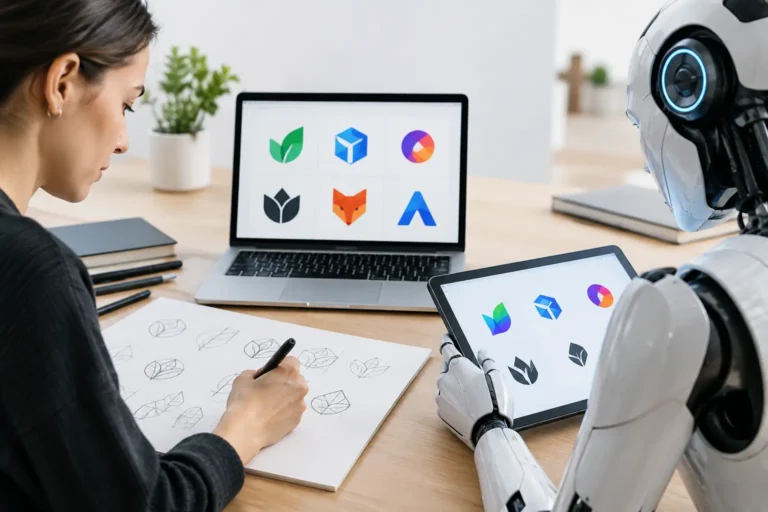

A logo generator can produce dozens of options before your coffee gets cold. That speed is tempting when you are launching a business, refreshing a storefront, or trying to get a new service online quickly. But the real question in custom logos versus AI is not whether artificial intelligence can make an image. It is whether that image can carry the weight of your business as customers, competitors, and new opportunities start paying attention.
For many small businesses, the best choice depends on what the logo needs to do next. A temporary graphic for a side project has different stakes than the visual foundation for a company you plan to grow. Understanding the difference helps you spend wisely now and avoid an expensive redesign later.
What AI Logo Tools Do Well
AI logo tools are built for speed, convenience, and experimentation. You enter a business name, choose an industry, select a few visual preferences, and receive logo concepts almost immediately. For an owner who is still testing an idea, that can be useful.
These tools are particularly good at helping you react to broad preferences. You may learn that you prefer a clean wordmark over an illustrated icon, or that muted colors feel more credible for your audience than bright, playful ones. They can also provide a quick placeholder when you need something simple for an internal presentation or a short-lived campaign.
The trade-off is that the tool is working from patterns, prompts, and preset design systems. It does not interview you about your best customers, ask why your business is different, or recognize that a competitor across town uses a nearly identical symbol. It can generate attractive options, but attractive is not the same as distinctive.
There are also practical considerations. Some AI platforms offer limited file types, unclear usage terms, or logos that are difficult to revise once you leave the platform. If your logo needs to work on signage, embroidery, social media, packaging, invoices, and a website, those limitations can become visible quickly.
Custom Logos Versus AI: The Business Difference
A custom logo is not simply a more polished image. It is the result of design decisions made for a specific business, audience, and purpose. A professional designer considers how your name reads at small sizes, whether the mark will reproduce clearly in one color, and what visual cues will help customers understand your position in the market.
That process matters because your logo often appears before you get the chance to make a personal impression. A prospective customer may see it on a search result, truck decal, social profile, proposal, or business card. In each setting, it quietly signals whether your company looks established, clear, and worth contacting.
With custom design, the designer can also challenge assumptions. You may arrive thinking you need a house icon because you run a real estate company, for example, but a designer can help you avoid the most overused category symbols and find a direction that feels more ownable. That does not mean every custom logo must be complicated. Often, the strongest marks are simple because they were simplified with intention.
AI can imitate familiar visual language very well. The risk is that familiar can slide into generic. If several businesses in your category use similar fonts, color combinations, and abstract icons, customers may not remember which one was yours.
Where Human Design Adds Value
The value of a designer is not just the final artwork. It is the judgment behind it. A human designer can turn incomplete ideas into a focused creative direction, then refine that direction based on real feedback rather than treating every preference as an isolated prompt.
Strategy before styling
A good logo needs a point of view. Are you positioning your business as premium, approachable, fast, traditional, technical, local, or national? Are you speaking to homeowners, procurement teams, parents, or other founders? The answers influence typography, color, composition, and tone.
AI can respond when you tell it to look “modern” or “trusted.” A designer helps define what those words should mean for your business. A law firm and a financial advisor may both want to appear trustworthy, but their visual identities should not look interchangeable.
Revision with context
Revisions are where many owners discover the limits of automated design. Asking an AI tool for “less corporate” or “more confident” can lead to a new batch of loosely related results. You are often restarting rather than improving.
In a managed custom process, feedback has continuity. Your designer and project manager can understand what is working, what is not, and why. That creates more purposeful revisions and keeps the project moving toward a logo you can use with confidence.
Files and ownership that support growth
A logo is a business asset, not just a profile picture. You may need a horizontal version for a website header, a stacked version for social media, a one-color version for uniforms, and vector artwork for large-format printing. These details are easy to overlook until a vendor asks for the right file.
Custom logo packages should provide the usable formats and clear rights you need to put your brand to work. At Logoworks, final deliverables are created for real business use, with full copyright ownership so your designs are yours.
When AI May Be the Right Starting Point
AI is not automatically the wrong choice. If you are validating a business concept, creating a personal project, or need a temporary visual while you prepare for a professional launch, an AI-generated mark may be enough for the moment.
It can also be a useful reference tool. Save a few examples that reflect colors, type styles, or moods you like. Then use them to communicate your preferences more clearly during a custom design project. The examples should guide the conversation, not define the finished logo.
Be cautious about using AI as the permanent answer when your business depends on reputation, referrals, recurring clients, or a competitive local market. In those cases, consistency and distinction are usually worth more than the initial savings.
How to Choose Based on Your Next 12 Months
Instead of asking which option is universally better, ask what your business will require over the next year. If you expect to print materials, build a website, hire employees, attend trade shows, or invest in advertising, your logo needs to perform across more than one screen.
Consider the cost of redoing work, too. A low-cost logo can become expensive if you later need to replace signage, social graphics, brochures, vehicle decals, and website assets because the original mark no longer fits the business you have become. Starting with a flexible, professionally built foundation can reduce that disruption.
It also helps to assess your own time. AI tools are quick to generate, but choosing among options, checking for similarity, working around file restrictions, and trying to make the logo consistent across materials still takes effort. A dedicated design partner gives you a clearer path and someone accountable for the finished result.
The Better Question Is What Your Brand Needs
Custom logos versus AI is ultimately a decision about priorities. AI offers immediacy and a low barrier to entry. Custom design offers strategic thinking, refinement, practical production support, and a visual identity made around your company rather than a generalized prompt.
Your logo does not have to explain everything you do. It should make your business easier to recognize, easier to trust, and easier to present consistently wherever customers find you. Choose the option that supports the business you are building, not just the task you need to finish this afternoon.