
A new location is opening in six weeks. Your website needs an update, sales needs a brochure, and your social profiles still use three different shades of blue. That is when the in house vs outsourced design decision stops being theoretical. The right choice affects more than your budget. It shapes how quickly your business can show up professionally when an opportunity arrives.
For most small businesses and growing brands, the question is not whether design matters. It is how to access skilled design without adding unnecessary cost, delays, or management work. An internal hire can make sense in the right circumstances. Outsourcing can bring expertise and flexibility that a small team cannot justify keeping on payroll. The best model depends on the volume, variety, and business value of the work ahead.
In House vs Outsourced Design: The Core Difference
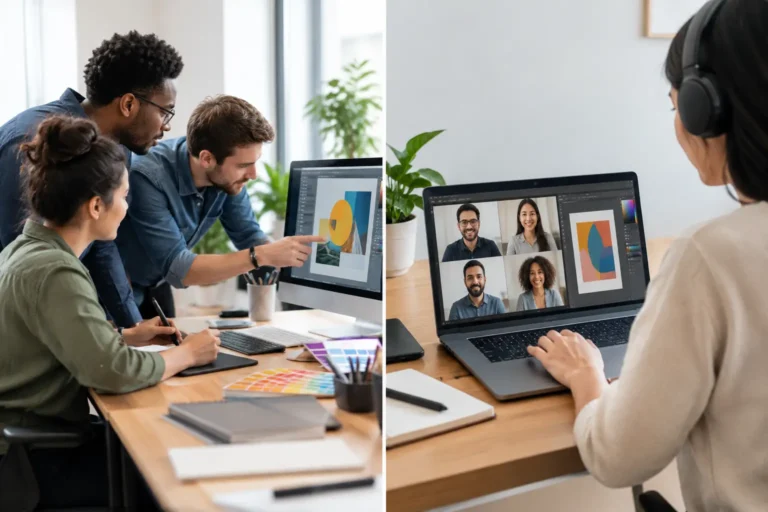
In-house design means employing a designer or creative team as part of your company. They work inside your systems, learn your operations, and are available for ongoing requests. You pay for their time whether the workload is heavy, light, or somewhere in between.
Outsourced design means working with an external partner, such as a design company, agency, or independent professional, for defined projects or ongoing support. You purchase the capability you need when you need it. The provider brings its own process, talent, and production capacity.
Neither approach automatically produces better work. Good design comes from clear strategy, strong creative talent, thoughtful feedback, and accountable project management. The more useful question is which model gives your business those essentials at a cost and pace you can sustain.
When an In-House Designer Makes Sense
An internal designer is often a smart investment when design work is constant, specialized, and closely tied to daily operations. A growing ecommerce brand may need frequent product launches, email campaigns, paid ads, packaging updates, and merchandising support. A company with a mature marketing department may also benefit from having creative talent in the room for rapid planning and iteration.
The biggest advantage is proximity. An in-house designer develops firsthand knowledge of your customers, products, internal stakeholders, and brand standards. They can make small changes quickly without a formal project kickoff. That familiarity is especially valuable when design must respond to fast-moving campaigns or complex internal workflows.
However, hiring internally is more expensive than comparing salaries alone. There are payroll taxes, benefits, software, equipment, recruiting time, onboarding, management, and professional development. A strong designer may also have a narrower specialty than your needs require. The person who excels at social content may not be the right fit for website UX, brand strategy, print production, or packaging.
There is also a workload question. If your business needs a new logo, a website, sales materials, and periodic marketing assets, you may not have enough steady work to justify a full-time role. Asking one person to cover every creative discipline can create bottlenecks and uneven results.
When Outsourced Design Is the Better Fit
Outsourcing is often the practical choice for startups, local businesses, and established companies that need polished work but do not need a full creative department. It lets you access the right level of expertise for a specific assignment, whether that is a foundational identity, a website refresh, a launch campaign, or a suite of branded collateral.
Cost predictability is a major benefit. A defined package or project scope gives you a clearer view of what you are purchasing before work begins. Instead of carrying a fixed annual salary, you can match spending to milestones that matter to the business, such as a rebrand, expansion, new service launch, or fundraising effort.
Outsourcing also expands your available skill set. A capable design partner can bring brand designers, web specialists, production expertise, and project management to the table. That matters because brand-building is rarely just one task. Your logo, color system, typography, website, presentation materials, and social assets should feel connected, even when they serve different purposes.
The trade-off is that an external team needs a clear brief and timely feedback. They cannot absorb your business context by sitting in internal meetings every day. The best partners close that gap with discovery, organized communication, dedicated points of contact, and a review process that keeps decisions moving.
Compare the Costs Beyond the Invoice
The least expensive option is not always the best value. A low-cost freelancer or design contest may appear attractive, but vague processes, inconsistent quality, and unclear ownership can create expensive rework later. On the other hand, hiring a full-time designer before there is enough work can leave you paying for capacity you are not using.
Start by estimating your annual design needs. Consider major projects, such as brand identity or website work, plus recurring needs like sales sheets, social graphics, promotional materials, and presentation updates. Then ask whether the work is predictable and continuous or project-based and variable.
An in-house hire is easier to justify when design demand consistently fills a professional’s workload and requires daily collaboration. Outsourcing tends to offer better value when your needs come in waves or require different specialties throughout the year. Many growing businesses use a hybrid model: an internal marketing lead protects brand consistency while an outside partner handles high-stakes creative projects and specialized production.
Control Is About Process, Not Just Location
Business owners sometimes assume in-house design provides total control while outsourcing means giving it up. In reality, control comes from a well-run process.
With an internal employee, unclear direction can lead to endless revisions just as easily as it can with an external provider. With an outsourced partner, clear objectives, decision-makers, timelines, and revision boundaries create productive collaboration. You should know who owns the project, when you will see concepts, how feedback is collected, and what happens when priorities change.
Ownership matters, too. Before hiring any provider, confirm what you receive at the end of the project. Your final brand assets should be usable across the channels your business relies on, and copyright ownership should be clearly stated. Design is a business asset, not a one-time decoration. You should not be left guessing whether you can use your logo on signage, packaging, advertising, or a future website.
Quality Depends on the Match
The quality question is less about internal versus external and more about whether the designer has the right experience for the assignment. Brand identity requires strategic thinking and a system that can grow beyond a logo. Website design requires attention to user behavior, content hierarchy, and mobile experience. Printed materials require technical production knowledge.
A generalist in-house designer may be ideal for day-to-day requests but need outside support for a complex rebrand. Likewise, an outsourced provider should not treat your business as a quick transaction. Look for a team that asks useful questions about your audience, positioning, competitors, goals, and where the work will appear.
Avoid choosing solely from a portfolio image or the lowest quote. Ask how the provider manages revisions, protects timelines, vets designers, and transfers final files. A professional process is often the difference between a design you merely like and a brand asset that helps customers trust you.
How to Choose the Right Model
If your team needs creative help every day, has a clear long-term workload, and can support the full cost of a hire, in-house design may be the right next step. If you need a defined set of high-quality deliverables, specialized skills, or flexible capacity, outsourcing is usually the stronger choice.
For many businesses, the decision does not have to be permanent. Start with the model that solves your most immediate business need without creating a larger operational burden. A new business may outsource its identity and website, then bring routine design work in-house later. An established company may rely on its internal team while bringing in outside experts for a major brand refresh.
The goal is not to build the largest creative operation. It is to give your business a clear, credible visual presence that supports the next stage of growth. A trusted partner such as Logoworks can provide custom brand and marketing design with defined pricing, dedicated support, and final assets that are 100% yours when an internal team is not the right fit.
Choose the arrangement that gives your team the confidence to act when opportunities appear, not the one that leaves great ideas waiting in a design queue.