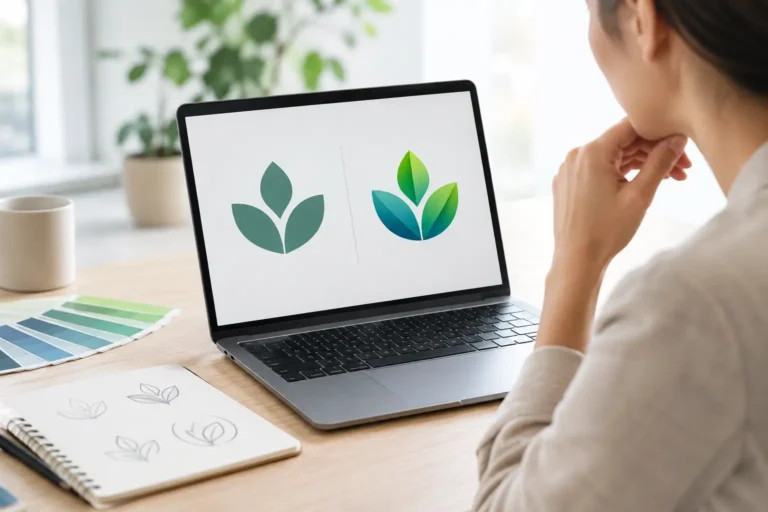

Your logo is on your website header, invoices, social profiles, packaging, proposals, and perhaps the sign outside your door. That visibility makes the question of when should you refresh a logo more than a design preference. It is a business decision that can affect credibility, recognition, and how confidently customers choose you.
A logo does not need to change simply because a new design trend appears. But it should not become an artifact that makes an otherwise capable business look dated, unclear, or disconnected from its customers. The right refresh preserves the equity you have built while making your brand easier to recognize and use everywhere it needs to work.
When should you refresh a logo?
Most businesses do not need a complete rebrand every few years. A well-designed logo can remain effective for a decade or longer. A refresh becomes worthwhile when it solves a clear problem – not when the owner is merely tired of seeing it.
Here are eight signs that your logo may no longer be serving your business as well as it should.
1. It looks dated next to your competitors
Design styles change, but the bigger issue is perception. If your logo relies on outdated effects, crowded typography, clip-art visuals, or color combinations that feel tied to another era, customers may assume your business is less current in other areas too.
This matters most in competitive categories where customers compare several providers before they call, book, or buy. A modernized mark can help your company look established and relevant without making it look like a completely different business.
2. Your business has outgrown what the logo represents
Many startups begin with a narrow service, a local audience, or a name chosen quickly to get the business moving. Growth can change all of that. Perhaps a landscaping company now offers commercial property maintenance, a boutique has become an online retailer, or a consultant has built a multi-person firm.
When your logo signals the old version of your company, it can create confusion or undersell your capabilities. A refresh gives your visual identity room to match the business you have become.
3. Customers misunderstand what you do
A logo does not have to illustrate your product or service literally. In fact, overly literal logos often become restrictive as companies grow. Still, your identity should support a clear first impression.
If prospects regularly ask whether you offer a service you do not provide, mistake you for another type of company, or fail to understand your market position, your logo and broader brand system may need attention. The issue may be the symbol, the name treatment, the tagline, or the way all of those elements appear together.
4. It does not work in digital spaces
A logo that looked fine on a storefront sign in 2012 may fail in a social media profile circle or mobile website header. Fine details disappear, long horizontal layouts become unreadable, and low-resolution files look unprofessional on modern screens.
This is one of the strongest practical reasons to refresh a logo. Your business needs a flexible identity system: a primary logo, simplified versions for small spaces, appropriate file formats, and colors that remain legible across digital and print applications. A logo is not just one image anymore. It is a working asset used in dozens of formats.
5. Your branding has become inconsistent
Take a quick look at your website, business cards, Google Business Profile, email signature, sales presentation, social channels, and printed materials. Do they look like they came from one company?
Inconsistency often starts when a logo was never built with a full brand system behind it. Teams improvise fonts, adjust colors, stretch files, and create alternate versions whenever a new need appears. Over time, that patchwork weakens recognition. A logo refresh is a good opportunity to establish usable rules for typography, color, spacing, imagery, and logo variations.
6. You are trying to reach a new audience
A shift in audience does not always call for a new name or a full rebrand. It may call for a more deliberate visual update. For example, a brand moving from bargain-focused messaging to a premium service model needs an identity that supports a higher-value experience. A local business expanding into new markets may need a cleaner, more universal look.
The trade-off is important: changing too much can distance loyal customers, while changing too little can make it harder to win the audience you want next. The goal is to evolve the brand with intention, not erase its history.
7. Your current logo creates production problems
Some logo issues are less visible until you try to use them. Maybe the design cannot be embroidered cleanly on uniforms. Maybe it prints poorly in one color, becomes muddy on promotional items, or requires constant adjustment for different vendors.
These are not minor inconveniences. Every workaround consumes time and increases the chance of inconsistent results. A professionally refreshed logo should be designed for the real-world places your business appears, from vehicle graphics and signage to invoices, apparel, packaging, and digital ads.
8. The logo was never professionally designed
Many strong companies begin with a DIY logo, a template, or a quick arrangement from an early-stage freelancer. There is no shame in that. Early resources are limited, and launching matters more than perfection.
But once your company depends on trust and repeatable marketing, a temporary logo can become a liability. A custom refresh can bring better typography, stronger proportions, clearer concept development, and files you fully own. It also gives you a brand foundation that is easier to scale.
Refreshing a logo versus rebranding
A logo refresh is an evolution. It keeps recognizable elements while improving execution. You might simplify the icon, refine the typeface, update the color palette, or create a more flexible layout. Customers can still recognize the business, but the identity feels more polished and current.
A rebrand is a larger strategic change. It may involve a new name, positioning, messaging, audience focus, visual identity, and customer experience. Rebranding makes sense when the business has changed fundamentally, such as after a merger, a major reputation issue, or a complete shift in services.
For most growing small businesses, a refresh is the smarter first move. It delivers a meaningful improvement without forcing you to rebuild every piece of customer recognition you have earned. A good designer can help determine whether your existing logo has enough equity to evolve or whether the underlying concept needs to be replaced.
How to refresh your logo without losing recognition
Before design begins, identify what customers already recognize. It might be a distinctive color, a familiar icon, a letterform, or a simple shape. Those elements do not have to remain exactly as they are, but they should be considered carefully.
Next, clarify what the new logo needs to accomplish. Do you need to look more premium? More approachable? More established? More legible on mobile devices? Clear objectives lead to better design decisions than a vague request to make the logo “modern.”
It also helps to audit every place the logo appears before launch. Your website, social accounts, email templates, printed materials, signage, uniforms, and sales documents should transition in a coordinated way. You do not need to discard usable materials overnight, but customers should not see two competing identities for months without a reason.
Finally, make sure you receive the right final assets. That includes vector files for print, web-ready files for digital use, color and black-and-white versions, and guidance on approved colors and spacing. Full ownership matters as well. Your logo should be your business asset, available whenever you need it.
Make the change at the right business moment
The best time to refresh is often before a major growth moment, not after. A new website, expanded services, market launch, product line, anniversary campaign, or updated sales strategy can all create a natural reason to bring your brand forward.
You do not need to wait until your logo is actively hurting your business. If it no longer reflects the quality of your work or the direction of your company, it is already asking customers to make an unnecessary leap of faith. A thoughtful refresh gives them a clearer reason to trust what comes next.