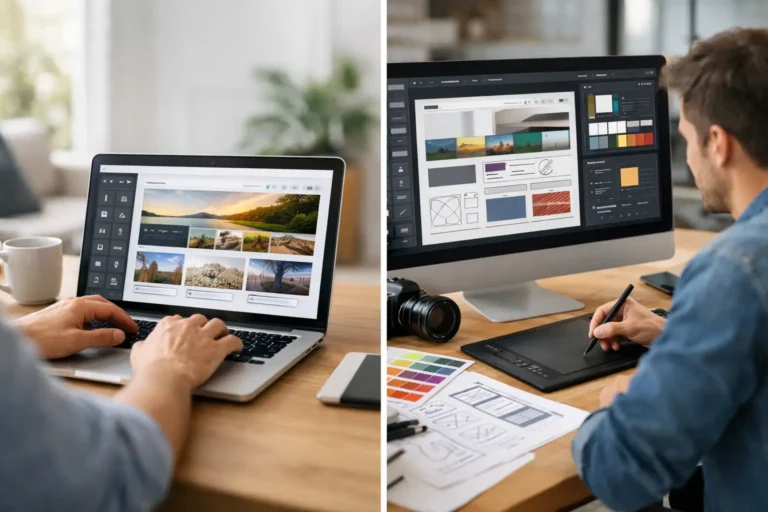

A website can make a small business look established before a customer ever calls, visits, or requests a quote. That is why the website builder versus custom design decision is not simply about how much you want to spend. It is a decision about how your brand will show up, how easily customers can find what they need, and whether your site can support the next stage of your business.
A template-based website builder can be the right starting point for some companies. A custom-designed site can be the stronger investment for others. The best choice depends on your goals, timeline, budget, internal resources, and how much your website needs to do beyond displaying basic information.
What You Get With a Website Builder
Website builders give business owners a structured way to create a site using pre-built templates, drag-and-drop sections, and standard features. You choose a layout, add your logo and colors, write your copy, upload photos, and publish. For a new business with a simple offer, that can be a practical path to getting online quickly.
The biggest advantage is speed. If you have clear content, a small number of pages, and someone on your team who is comfortable working with digital tools, you may be able to publish a basic site within days. Builders also tend to package hosting, security updates, mobile formatting, and common tools in one monthly subscription.
That convenience comes with boundaries. Your site is built within the builder’s system, so your layout, navigation, functionality, and code-level options may be limited. You can make a template look cleaner with good images and thoughtful copy, but you may still recognize the underlying pattern from other sites in your industry.
This does not make website builders a bad choice. It means they work best when the website has a focused job: introduce the business, explain the service, share contact details, and collect a few leads. A local service provider, consultant, or early-stage startup may not need more at first.
Where Website Builders Can Fall Short
A website should not merely exist. It should help customers trust you and take action. When the template, visuals, and messaging do not match the quality of your work, visitors can sense the disconnect.
Templates are designed to serve many industries at once. As a result, they may force your business into generic sections and predictable page structures. You might struggle to present a unique process, explain a complex service, feature the right proof points, or direct visitors toward the action that matters most.
The do-it-yourself approach also has a hidden cost: your time. Choosing a template, making design decisions, sizing images, rewriting sections for mobile, testing forms, and troubleshooting can take far longer than expected. Founders often start with the goal of saving money, then spend evenings trying to make a site feel polished enough to represent their company.
Brand consistency is another common issue. If the logo, colors, type choices, photography, and social media graphics were created separately, a builder will not solve that problem on its own. It can actually make inconsistency more visible by placing mismatched brand elements across a highly public customer touchpoint.
Website Builder Versus Custom Design: The Real Difference
Custom web design begins with your business, not a preset layout. The design is planned around your audience, your brand identity, your offerings, and the actions you want visitors to take. That may mean a more strategic homepage structure, clearer calls to action, dedicated landing pages, stronger service pages, or a portfolio that tells a more convincing story.
A custom design process should also consider the details that shape credibility. Does the visual hierarchy help people scan the page? Does the navigation make sense for a first-time visitor? Are your testimonials, certifications, case studies, and contact options placed where they can build confidence? Does the mobile experience feel intentional rather than compressed?
The value is not that every element looks different for the sake of looking different. The value is that the site works harder for your business. A good custom site gives customers a clear reason to stay, understand what you offer, and contact you.
Custom design is especially useful when your company has outgrown a basic online brochure. If you are competing in a crowded market, serving higher-value clients, running paid campaigns, selling multiple services, or building a recognizable brand, your website needs more than a clean template. It needs to support the way you sell.
When a Website Builder Is the Smarter Choice
A website builder may be the sensible option when your business is validating an idea, your budget is tightly limited, or you need a simple temporary presence while other parts of the business take shape. It is also a reasonable fit if you are comfortable maintaining the site yourself and do not need specialized features.
Choose a builder with realistic expectations. Start with a solid logo, a defined color palette, professional photos where possible, and concise copy that answers the questions customers actually ask. Keep navigation simple and avoid adding every available feature. A short, focused site often feels more trustworthy than a cluttered one.
A builder can also serve as a bridge. You can launch a basic version now, learn what customers respond to, and invest in a custom site once you have stronger messaging, customer proof, and a clearer view of your growth priorities.
When Custom Design Is Worth the Investment
Custom design is often the better choice when the website will play a meaningful role in lead generation, sales, recruiting, or brand perception. It is also the right call when an inconsistent or dated website could cost you opportunities.
Consider custom design if any of these situations sound familiar:
- Your current brand looks different across your website, social channels, proposals, and printed materials.
- Prospects need more education before they are ready to buy or request a consultation.
- You offer several services, serve distinct customer groups, or need dedicated pages for campaigns.
- Your team is spending too much time trying to update a template without getting the result you want.
- You need a professional site that reflects premium pricing, expertise, or a more established market position.
The upfront investment is higher, but the outcome can be more durable. A thoughtfully designed website gives you a stronger foundation for marketing and lets your business present itself with consistency as it grows.
Compare the Full Cost, Not Just the Starting Price
The price of a website builder is easy to see: a monthly subscription, perhaps a premium template, and optional add-ons. The cost of a custom website is usually more visible upfront. But comparing only those figures can lead to the wrong decision.
Ask what each option requires from your team. With a builder, who will write the copy, select images, organize the pages, set up forms, maintain the site, and fix issues? If the answer is you, account for the hours involved and the revenue-producing work that may be delayed.
With custom design, ask what is included. A dependable design partner should make the scope clear, explain the process, show how revisions work, and define what you will own at the end. You should know whether branding, copy support, mobile design, landing pages, and future updates are part of the package or separate services.
Ownership matters. Your business should have clear rights to its final design assets and the ability to use them across your marketing. That protects your investment and prevents your brand from being tied to a single vendor’s system or unclear licensing terms.
Start With Your Business Goals
Before choosing a platform or requesting a quote, get specific about what success looks like. Do you need more calls from local customers? A site that supports a new brand launch? Better-qualified leads? A stronger presentation for investors, partners, or larger clients? The answer should guide the design decision.
For many growing businesses, the most effective approach is not choosing between speed and quality forever. It is choosing the right level of investment for the business you are building now. Logoworks helps businesses pair professional brand foundations with custom website design, so the final result feels connected rather than assembled from separate pieces.
Your website does not have to be the most elaborate site in your market. It does need to make the right impression, answer customer questions clearly, and give people a confident next step. Build for that purpose, and the right choice becomes much easier to see.