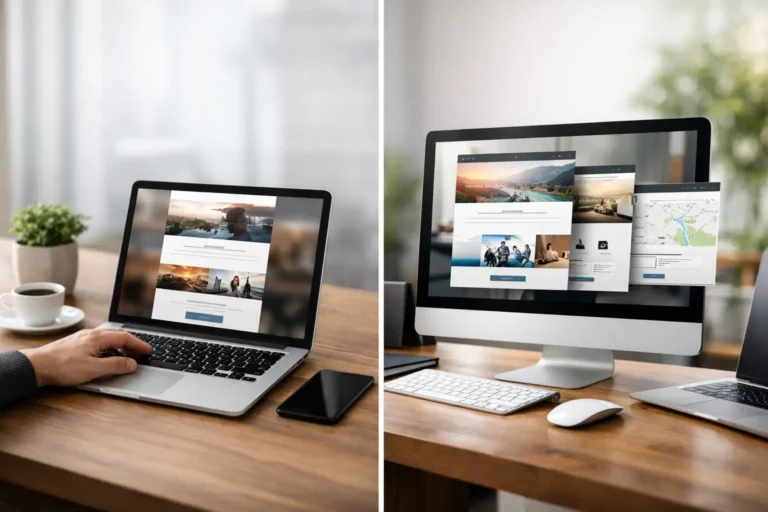

A visitor has just a few seconds to decide whether your business feels credible, relevant, and easy to work with. That is why the single page vs multipage website decision is more than a design preference. It shapes how customers find you, understand your offer, and take the next step.
For a small business, the right choice usually comes down to one question: are you trying to drive one focused action, or help customers explore a broader business? A polished site should make that answer obvious, not bury it behind unnecessary pages or an overloaded scroll.
What Is a Single-Page Website?
A single-page website presents your core message, services, proof, and call to action on one long, scrolling page. Navigation links typically move visitors to sections on that same page rather than opening separate URLs.
This format works best when your message is focused. A new business promoting one signature service, a consultant booking discovery calls, or an event with a clear registration goal can benefit from a page that leads visitors through a carefully planned sequence. The visitor sees the problem, the value proposition, the proof, and the next step without needing to decide where to click.
A strong single-page site is not simply a shorter site. It still needs a clear hierarchy. The opening section should quickly state what you do and who you help. From there, the page can introduce benefits, show examples of work, answer common concerns, and make contacting or purchasing easy.
Where single-page websites perform well
Single-page sites are especially effective for paid advertising campaigns, product launches, local service promotions, portfolios with a narrow focus, and early-stage businesses validating an offer. They keep the customer journey contained and reduce distractions.
They can also be faster and more affordable to launch because the design team is concentrating on one complete experience. That does not mean the work is less strategic. Every section has to earn its place, since there is no separate services page or FAQ page to catch missing information later.
What Is a Multipage Website?
A multipage website uses separate pages for distinct topics. A typical structure might include Home, About, Services, Portfolio, Reviews, Blog, and Contact pages. Each page has its own purpose and can speak to a different customer question or search intent.
This approach gives growing businesses room to explain what makes them different. A contractor can create dedicated pages for kitchen remodeling, bathroom remodeling, and commercial work. A professional services firm can separate its practice areas, team bios, case studies, and resources. Visitors can go straight to the information that matters to them.
Multipage sites also make a company feel more established when the business has a meaningful amount of information to share. That credibility does not come from page count alone. It comes from useful content, clear organization, consistent branding, and an experience that makes customers confident they have found the right partner.
Where multipage websites perform well
A multipage structure is usually the better fit for companies with several services, locations, audiences, or products. It is also well suited to businesses that want to build organic search visibility over time. Separate, purposeful pages give search engines and prospective customers clearer signals about what your company offers.
For example, a dental practice may need individual pages for preventive care, cosmetic dentistry, emergency visits, insurance information, and new-patient resources. Trying to fit all of that on one page can create a long, tiring experience where essential details become hard to find.
Single Page vs Multipage Website: The Real Trade-Offs
The strongest choice is not automatically the larger one. It is the structure that supports your current sales process while leaving room for the business you plan to become.
Customer focus versus customer choice
A single page controls the narrative. You can guide someone from headline to action with fewer decision points, which is valuable when you have one primary offer and one desired conversion, such as requesting a quote or booking a consultation.
A multipage site gives visitors more control. That is useful when buyers arrive with different needs. One visitor may want pricing, another may want examples of past work, and a third may need to understand your process before reaching out. The trade-off is that each page needs a clear job. More navigation options can create friction if the structure is not intuitive.
Search visibility and content depth
Search performance often favors multipage websites because each service, product category, or location can have a dedicated page built around a specific topic. This gives you more opportunities to appear when customers search for solutions you provide.
A single-page website can still be optimized well, particularly for a branded search, a local audience, or one tightly defined service. But it has limits. One page cannot fully address every service and customer question without becoming excessively long and less focused. If organic search is a major growth channel, a multipage plan is often the smarter long-term investment.
Speed to launch and ongoing maintenance
A single-page site can be the faster route when you need a professional presence now. It has fewer layouts, fewer content decisions, and a simpler approval process. For a startup with a new offer, that speed can matter.
A multipage site requires more planning, writing, and design production upfront. It also needs continued attention as services change, team members join, or new resources are added. In return, it gives you a cleaner foundation for expansion. The upfront cost is higher, but rebuilding an undersized website six months later can cost more than planning appropriately from the start.
Brand storytelling and credibility
Your website is one of the few places where you control the full impression of your business. A single page can tell a persuasive, highly visual story when your offer is simple. It is often ideal for brands that need a clean, modern digital introduction.
A multipage site has more room for proof. Detailed case studies, testimonials, team backgrounds, process explanations, and answers to buyer concerns can all support a higher-consideration purchase. If customers need time and reassurance before committing, those pages can do meaningful sales work around the clock.
How to Choose the Right Website Structure
Start with your primary conversion goal. If nearly every visitor should take the same action, such as calling for an estimate or joining a waitlist, a single-page website may give you the focus you need. Make sure the page includes enough proof and practical information to earn that action.
Choose a multipage site if your business offers multiple services, serves distinct customer groups, has several locations, or relies on content to attract search traffic. It is also the better option when your sales process involves research. Customers should be able to find answers without feeling like they are reading one endless brochure.
Think honestly about what you will need in the next 12 to 24 months. A solo consultant may begin with one core service and a single page, then add pages as demand grows. A company that already knows it will offer several specialized services should not force everything into a one-page format just to keep the first launch simple.
Your visual identity matters in either case. Consistent colors, typography, imagery, and messaging help every page or section feel connected. A professionally designed website should not only look polished. It should make the path from interest to inquiry feel clear and trustworthy.
A Practical Middle Ground
The choice does not have to be permanent. Many businesses begin with a focused landing page while they refine their offer, then expand into a multipage website when they have stronger proof, broader services, or more search opportunities.
Another effective option is a compact multipage site. Rather than launching with ten thin pages, build a strong home page plus dedicated Service, About, and Contact pages. This gives visitors useful choices without creating content for content’s sake. As your business grows, you can add portfolio pieces, service details, location pages, or educational resources where they will genuinely help customers.
At Logoworks, website design is approached as part of the larger brand experience. The goal is not to sell you more pages than you need. It is to create a professional foundation that reflects your business, supports your next step, and gives customers confidence in choosing you.
Start with the customer action that matters most, then build only the path required to make that action feel easy. A website earns its value when it gives your business a clearer, more credible way to grow.